- 2008: Medical Justice detailed nearly 300 cases of alleged physical assault and racial abuse by private security guards in the deportation process.
- March 2010: G4S (and other security contractors involved in deportation) had failed to manage the use of violent restraint.
- October 2010: A Colombian deportee was badly injured when forced onto an aircraft by G4S.
- October 2010: An Angolan asylum seeker died at the hands of G4S during a forced deportation. Two of the guards face criminal charges and G4S are still waiting to hear whether they face corporate manslaughter charges.
- A report by PAFRAS (Positive Action for Refugees and Asylum Seekers) in 2008 interviewed former detainees about their experiences in detention. Five of them encountered racism from the staff in detention centres.
- April 2010: a 40 year old Kenyan detainee died at G4S's Oakington detention centre, partly due to neglect of his medical condition.
Wednesday, 15 February 2012
Sheffield takes a stand against G4S
Yorkshire academics, activists and organisations working within the refugee-related sector have had their suspicions of the multinational corporation, G4S, for a long while. Group 4 Securicor, the conglomeration formed when Securicor merged with other security companies, have recently been deemed the 'preferred' bidder for a huge government contract that would see this profitable private company being responsible for the provision of social housing for asylum seekers in the whole Yorkshire and Humberside region.
This is not a regional anomaly. All across the country, these housing contracts are being taken away from Local Authorities and offered to huge, multinational security companies such as Serco, Reliance Security and G4S.
G4S are responsible for a huge variety of security jobs, from emptying cash machines to providing security guards for multi-million dollar events. Recently, they have been awarded a £100 million contract for running security inside the Olympic Park. Working alongside the British Army and their ammunition, G4S seems to have a very cosy relationship with government authorities. One of its current directors is the former Home Secretary John Reid.
Over the past years, G4S has consolidated its position as the preferred private company to manage the practicalities of the UK's justice system. In 2011, G4S managed 675 court and police cells, four detention centres for asylum seekers, and since summer 2011, they have managed the notorious 'family friendly' detention centre at Pease Pottage.
The UKBA has confirmed that the new asylum housing contracts will be given to companies with a good reputation. Unfortunately, a comprehensive portfolio of government contracts cannot suffice as a "proven track record". Until 2011, G4S were also responsible for the transportation, forcible deportation and dispersal of asylum seekers, but lost this contract due to the revelation of their appalling treatment of people in their care.
This list, compiled by South Yorkshire Migration and Asylum Action Group, proves that G4S has a far from a stellar reputation:

Wednesday, 8 February 2012
Freedom of the Press?
Investigative journalists and reporters are often victims of repressive regimes and as a consequence, seek asylum in more permissive countries across the globe. The international organisation, Reporters without Borders, has compiled their annual World Press Freedom Index for 2011/12. The UK ranks at number 28 internationally, lower than much of Scandinavia, whilst the recurrent crackdown on revolutions in the Middle East have worsened an already limited freedom of press in countries such as Syria.
Check out Reporters without Borders' report and revealing info graphic.
Check out Reporters without Borders' report and revealing info graphic.
G4S is not a landlord; it's a private security army
After the publication of a letter signed by a multitude of Yorkshire Academics declaring their discomfort with the subcontracting of asylum seekers' social housing provision to multinational corporations - G4S, Serco and Reliance Security - John Grayson, a member of the South Yorkshire Migration and Asylum Action Group and a lecturer at Sheffield Hallam University, has written a striking article that pushes home the importance of resisting government changes to housing provision.
Calling the government's "preferred bidders" for the Yorkshire and Humberside region, G4S, a "private security army" rather than landlords, Grayson details G4S' history of providing poor, and sometimes lethal, services in the detention centres and dispersal procedures that it currently runs. Grayson continues to highlight the dangerous commodification of such critical services:
As the coalition commits itself to deficit reduction and austerity, its zeal for outsourcing to huge, profit-making, private companies must be kept in check. It has already been reported that the initial contracting of private companies to provide asylum seekers' social housing produced “a housing system which in many instances was poorly regulated, substandard and unsafe” according to the Institute for Race Relations. To grant a private contract which has already been heavily criticised to a company that has a non-existent record of providing dignified and safe services is more than ludicrous; it is highly dangerous. Decisions made by government officials and corporate executives, so far removed from the precarious lives of the people on whom the changes would impact, are set to further endanger the wellbeing and safety of asylum seekers across the country. This is something we must all resist.
Calling the government's "preferred bidders" for the Yorkshire and Humberside region, G4S, a "private security army" rather than landlords, Grayson details G4S' history of providing poor, and sometimes lethal, services in the detention centres and dispersal procedures that it currently runs. Grayson continues to highlight the dangerous commodification of such critical services:
Although G4S’s slogan is “Securing Your World” its policy and practice is more accurately expressed by a recent description of the US private sector detention and deportation industry: ‘Every prisoner a profit centre, every immigrant a business opportunity’.
As the coalition commits itself to deficit reduction and austerity, its zeal for outsourcing to huge, profit-making, private companies must be kept in check. It has already been reported that the initial contracting of private companies to provide asylum seekers' social housing produced “a housing system which in many instances was poorly regulated, substandard and unsafe” according to the Institute for Race Relations. To grant a private contract which has already been heavily criticised to a company that has a non-existent record of providing dignified and safe services is more than ludicrous; it is highly dangerous. Decisions made by government officials and corporate executives, so far removed from the precarious lives of the people on whom the changes would impact, are set to further endanger the wellbeing and safety of asylum seekers across the country. This is something we must all resist.
Tuesday, 7 February 2012
Structures of Sanctuary: destitution support in the age of austerity
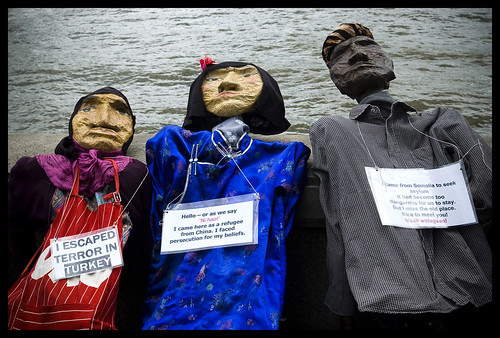
A derelict working men's pub in the heart of central Manchester could soon be transformed into a support centre for destitute asylum seekers in the region. Volunteers from The Boaz Trust and other supportive organisations will renovate the ageing pub into a shelter for individuals who have been made destitute by our UK asylum system.
The most common cause of destitution for asylum seekers is in the post-refusal limbo created by our immigration laws. Once all avenues of appeal and re-appeal have been exhausted, any previous asylum support - meaning housing, government vouchers, any benefits - is withdrawn within 21 days. The government expects asylum seekers, after months of excruciating legal procedures and recalling trauma, to be able to leave the UK within 3 weeks of receiving their refusal.
Some individuals who fit a difficult criteria qualify for 'Section 4', a post-refusal government support system that is given to those who cannot return to their country of origin due to personal safety or other reasons, but agree to return when it is possible. It is worth noting the slight contradiction in terms that a 'refused' asylum seeker is granted support rather than status when their situation is considered too dangerous to return. According to a study by the Joseph Rowntree Trust, many refused asylum seekers are too scared to apply for Section 4, fearing that further correspondence with the authorities will result in their deportation, not their support. Section 4 only provides quasi-derilict housing and £35 in government vouchers per week, a small fraction of what the government considers adequate income support for 'native citizens.'
A recent report by the Red Cross revealed that 59% of questioned asylum seekers had been destitute for at least 1 year. Unable to work - either when awaiting status or whilst destitute - asylum seekers are forced either onto state support (which is incredibly limited) or into poverty and destitution. In 2009, the London School of Economics estimated that there were 500,000 refused asylum seekers in the UK. With the onslaught of government cuts, these precarious lives are reliant on the support of various charitable organisations, compassionate friends and relatives or on handouts from faith groups. Britain acts as a place of survival, not sanctuary.
Considering the horrific situations many asylum seekers are escaping from, it is not surprising that many are unwilling to immediately leave the UK. It is important to remember that many of the negative initial decisions of the UKBA are overturned on appeal; a quarter of refused asylum seekers were unjustly asked to leave the UK in the last quarter of 2011.
When the coalition is unlikely to make the necessary drastic changes to our asylum and immigration policy, initiatives such as the destitution support centre in Manchester are all the more important. This is not government-sponsered Big Society, but government-enforced Big Society; independent charitable organisations are forced to fill the gaps created by dwindling state support. We should not thank the generous government, but this is not a reason to turn our backs on crucial social issues. We must use this opportunity to create autonomous centres that promote dynamic social change. We do not have to follow Cameron's "big society" narrative; it is time for communities to take back authorial power.
Image (c)AmnestyUK
Friday, 3 February 2012
Yorkshire Academics Reveal Fear Over New Asylum Housing Contracts
A open letter written by a wide selection of academics and researchers revealing their fear over the new asylum housing contracts has been published in todays Yorkshire Post. Signed by academics from all across the Yorkshire region, including lectures from Leeds University and Leeds Metropolitan University, the letter explains that:
Continuing to detail the various problems, both practical and ideological, with the contracting of these private companies to deliver crucial social services, the authors focus on the multinational corporation, G4S, that has been awarded the contract for the Yorkshire and Humber region. G4S is the second largest private employer in the world (on a similar level to Serco, another private company awarded a social housing contract for asylum seekers in England) and have numerous government contracts that amount to around £600 million.
Considering that some of these private companies have dubious records in their previous dealings with asylum seekers, it is hardly surprising that these new contracts are being met with such suspicion. The coalition can only remove state support if they are able to seamlessly integrate private companies to fill the gap. We must be critical, sensitive and resistant to these drastic changes to the fabric of social welfare, or we can expect to see it gradually destroyed by an influx of underregulated, profit-hungry private business. In the words of these Yorkshire academics, "We believe few people in Yorkshire if they were told would believe their taxpayers money should be awarded to such a company to manage asylum seeker housing."
As researchers and university teachers in the fields of housing and immigration in the Yorkshire region we oppose the plans of the Coalition government, through the UK Border Agency (UKBA), to award national contracts of around £135 million for managing asylum seeker social housing to the three multinational security companies who manage most immigration detention centres, and forcible deportations in the UK; G4S, Serco, and Reliance.
Continuing to detail the various problems, both practical and ideological, with the contracting of these private companies to deliver crucial social services, the authors focus on the multinational corporation, G4S, that has been awarded the contract for the Yorkshire and Humber region. G4S is the second largest private employer in the world (on a similar level to Serco, another private company awarded a social housing contract for asylum seekers in England) and have numerous government contracts that amount to around £600 million.
Considering that some of these private companies have dubious records in their previous dealings with asylum seekers, it is hardly surprising that these new contracts are being met with such suspicion. The coalition can only remove state support if they are able to seamlessly integrate private companies to fill the gap. We must be critical, sensitive and resistant to these drastic changes to the fabric of social welfare, or we can expect to see it gradually destroyed by an influx of underregulated, profit-hungry private business. In the words of these Yorkshire academics, "We believe few people in Yorkshire if they were told would believe their taxpayers money should be awarded to such a company to manage asylum seeker housing."
Wednesday, 1 February 2012
Fortress Europe
A set of statistics gathered by UNITED for Intercultural Action, a European network against nationalism, racism, fascism and in support of migrants and refugees, has shown that between 1993 and 2011, 15,551 refugees died as a consequence of border militarisation, asylum laws, poor accommodation, detention policy, deportations and carrier sanctions (amongst other features of Fortress Europe).
Faced with a terrifyingly detached set of numbers and columns, it is important to remember the people behind the statistics. 15,551 individuals died as a direct consequence of European attitudes to freedom of movement, settlement and identity. Destructive asylum and immigration policy is not an abstract error; it has unmistakably human consequences.
Faced with a terrifyingly detached set of numbers and columns, it is important to remember the people behind the statistics. 15,551 individuals died as a direct consequence of European attitudes to freedom of movement, settlement and identity. Destructive asylum and immigration policy is not an abstract error; it has unmistakably human consequences.
Subscribe to:
Posts (Atom)